Datasets
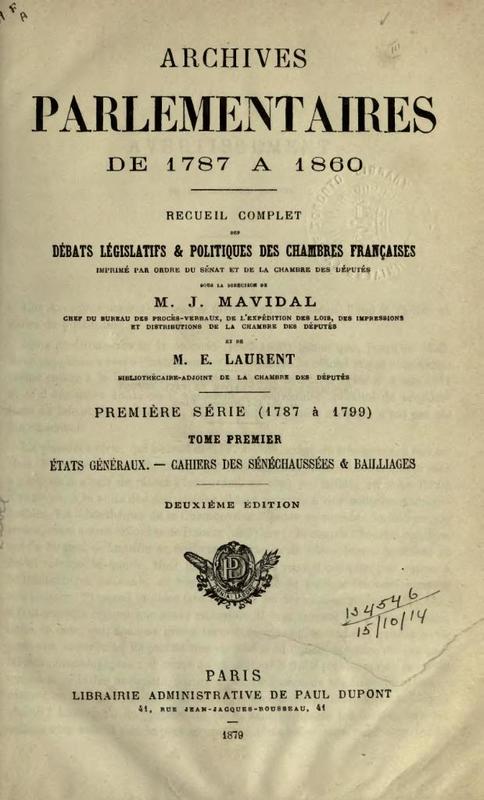
At its core, the project will involve a systematic analysis of references to Carthage between 1789 and 1799 in two overlapping sources: the Moniteur universel and the Archives parlementaires. These two sources provide a window into a variety of documents, most notably the minutes of the various national assemblies, as well as reports, speeches, and letters.
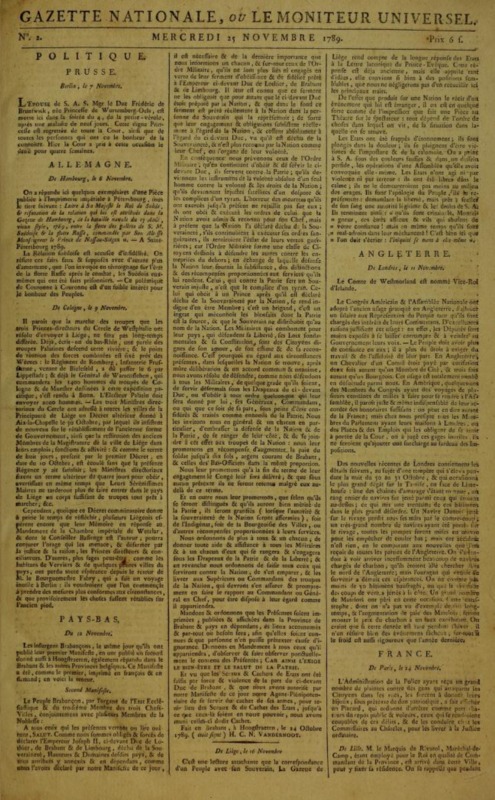
The Moniteur universel was a newspaper founded by Charles-Joseph Pancoucke in November 1789 that quickly established itself as the quasi-official newspaper of the French government. Mostly focused on reporting parliametary speeches and debates, the newspaper also included foreign news, court verdicts, book reviews, and poems.
The Archives parlementaires, meanwhile, is an ambitious and ongoing project to produce the definitive collection of French legislative history between 1787 and 1860, with its first series devoted entirely to the French Revolution. Consequently, the Archives parlementaires not only includes all of the legislative material from the Moniteur universel, but is supplemented by a wide variety of additional printed and archival material.
Using these two sources as the datasets for the project offers several notable advantages. They are both available online, meaning that they are readily accessible and in a format that is generally conducive to digital analysis. They also provide a clearly defined corpus with a generally equal level of coverage from year to year, something which allows us to draw meaningful quantitative comparisons over time. Finally, and perhaps most importantly, they offer a view into the discourse that shaped and defined public opinion across France. The articles, debates, and letters that we find within these two sources were transmitted across France; thus, the ways in which they discussed and presented the ancient Carthage disseminated throughout society and influenced how the Punic city was perceived throughout the country.
Formats
Having considered the scope of the primary sources, we should also briefly consider formats in which they appear.
The Moniteur universel is found in two forms, in the original eighteenth-century publications (hereafter abbreviated M.U.) and in a nineteenth-century reprint edited by Léonard Gallois (the Réimpression de l'ancien Moniteur, hereafter abbreviated R.M.). The former is available online courtesy of the Internet Archive while the latter can be accessed in Google Books. While R.M. is easier to work with due to its much clearer typsetting, the reprint cannot be used for the entire period: after volume 25 (which ends on September 22, 1795), the reprint becomes so highly abridged as to be rendered effectively useless.[1] Thus the analysis utilizes both M.U. and R.M. up until this date, after which it uses only M.U.
As for the Archives parlementaires, they are available in the French Revolution Digital Archive in a highly accessible format (as discussed in Methodology: Data Acquisition). Indeed, given the fact that the Archives parlementaire is available in a much more usable format and that it offers a much fuller selection of sources, it might seem puzzling that this project uses both the Archives parlementaires and the Moniteur universel. Unfortunately, there are two serious limitations that preclude the exclusive use of the Archives parlementaires.
Firstly, although the project has lasted for over a century and has produced 103 volumes (with volume 104 currently awaiting publication), the first series of the Archives parlementaires is currently only about halfway done, having not even reached the end of 1794. Furthermore, virtually all of the volumes that the Archives parlementaires has completed for the year 1794 have not been digitized because they were published much more recently and so are still under copyright. Thus, while it is an invaluable source, the Archives parlementaires can only be used until January 4, 1794.
1 Andrew Jainchill, Reimagining Politics after the Terror: The Republican Origins of French Liberalism (Ithaca: Cornell University Press, 2008), xi–xii.
As an indication of how stark the change is after this date, consider that M.U. devotes its first twenty-five volumes to the six-year period between May 5, 1789 and September 22, 1795, and then crams the next four years between September 23, 1795 and November 15, 1799 into just four volumes. This means that volumes one through twenty-five cover on average roughly three months per volume, while volumes twenty-six through twenty-nine cover an entire year per volume.