The Initial Question
Paris, May 26, 1794. For over a year, the young French Republic had been locked in war against nearly all of Europe. Though no longer fighting for its survival as it had been back in the desperate months of 1793, France’s victory seemed far from assured. The previous year, the nation had been stunned by military defeats and domestic revolts, notably in the west and south of France. While these rebellions had been ruthlessly suppressed, with thousands summarily executed, leaders of the revolutionary government continued to see enemies and traitors everywhere. Since September 1793, a new Law of Suspects targeted hundreds of thousands of individuals for preemptive incarceration. The highest echelons of government were not insulated from this paranoia: in January 1794, both the more radical Hébertists and the more moderate Dantonists had been tried and executed. In June, the Great Terror would begin with the infamous Law of 22 Prairial, which limited the sentences of the revolutionary tribunals to two choices: acquittal or death.
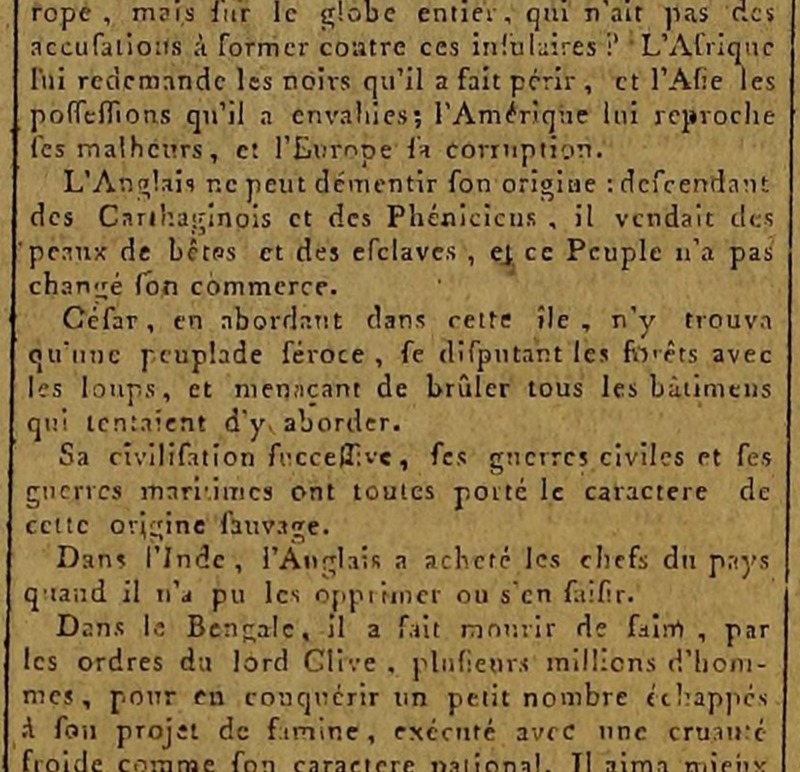
On this day, May 26, in an atmosphere of growing violence and paranoia, Bertrand Barère mounted the tribune of the National Convention. Barère, a leading figure in the revolutionary government, stood to deliver aloud his Report on the Crimes of England against the French People and on its Outrages against the Liberty of Nations. In this anglophobic diatribe, one sentence in particular caught my attention,
For, having surveyed the breadth of British crimes around the globe, Barère declared:
“The Englishman cannot deny his origin: descendant of the Carthaginians and the Phoenicians, he sold the skins of animals and slaves, and this people has not changed its commerce. Caesar, landing on this island, found there nothing but a ferocious people, fighting against wolves for the forests… Its successive civilization, civil wars, and maritime wars have all borne the character of this savage origin.”[1]
Barère’s recourse to ancient history here is unexpected, and at first blush seems baffling. Why, in a moment of profound crisis, did he harken back two millennia to a long-dead civilization and link it to the modern day? Why did he assume that his listeners would be familiar with the ancient Punic city and that his reference would require no further explanation? And most of all, why was he convinced that assigning the British a fictitious Carthaginian ancestry would be a rhetorically effect tactic, one that would be met not with bewilderment or derision, but with enthusiasm and acclaim?
We might perhaps be inclined to dismiss these remarks as aberrations, either unique to this speech or representing some particular quirk of Barères’s. Yet a search of parliamentary records and official newspapers reports shows no fewer than ninety-two occasions on which speakers and writers drew analogies between Britain and Carthage over the course of the French Revolution. Clearly a considerable number of revolutionaries believed this to be a forceful comparison. What was the rhetorical force of the comparison, and how are we to understand it? Why did the revolutionaries care about Carthage at all?
[1] A.P., 91:36; R.M., 20:583
[“L'Anglais ne peut démentir son origine : descendant des Carthaginois et des Phéniciens, il vendait des peaux de bêtes et des esclaves, et ce peuple n'a pas changé son commerce. César, en abordant dans cette île, n'y trouva qu'une peuplade féroce, se disputant les forêts avec les loups, et menaçant de brûler tous les bàtimens qui tentaient d'y aborder.”]