Investigation of 1667
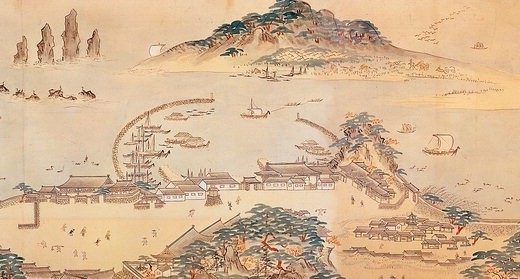
On 19 March 1671, an annual ceremony called hekisho (“wall writings” 壁書) began at the Japan House (倭館), a bustling entrepôt on the southeastern tip of the Korean peninsula. This day, Japanese official Tōbō Sazaemon (唐坊佐左衛門) recited wall writings that held grave importance for his trading post, and future interactions between his two patron states – Tokugawa Japan (1603-1868) and Chosŏn Korea (1392-1910). After assembling thousands of Japan House residents, Tōbō rehearsed a long list of regulations against gambling, inebriation, quarrels and other disorderly behavior that threatened his community. Overlooking a crowd that never ran short of unruly samurais and profiteers, he declared his first injunction, probably in an echoing, accusatory timbre: “All weapons trade with foreigners is banned.”
Tōbō’s injunction was in fact a prohibition issued by the bakufu fifty years ago. In 1621, Tokugawa authorities forbade all foreign trade of weapons, meting out draconian punishment to smugglers in high-traffic Japanese ports like Nagasaki and Hirado. But at the Japan House, arms trafficking would perdure for another fifty years. By the late 1660s, the situation exacerbated to the point where a smuggling incident in 1667 blew up into diplomatic disputes. In fact, Tōbō’s wall writings ceremony was a response to this incident, as the bakufu pressured Tōbō and his supervisors in Tsushima to tighten control at the source – the Japan House.
The smuggling incident of 1667 was a crucial exposé of gunrunning activities between Tokugawa Japan and Chosŏn Korea. As the Nagasaki investigations revealed, a vast network of smugglers traversed the Japan House during the seventeenth century. This network included smugglers in Tsushima, the historic breeding ground of such types, as well as financiers, interpreters and brokers in far-flung regions of the archipelago such as Nagasaki, Hakata, Yanagawa and Osaka. In the end, 87 out of 94 suspects were found guilty and executed. Records show that these men had trafficked Japanese guns and ammunition into the peninsula over multiple transactions from 1662 to 1666.
As all treacherous transactions go, gunrunning took two to tango – daring Japanese profiteers on one end, and eager Korean clients on the other. On the Korean side, accomplices were also widespread. Starting with Tongnae merchants (東萊商) in the vicinity of the Japan House, the Korean network probably included financiers in Seoul, ginseng merchants in Kaesŏng, and local proxies in Pyŏngan Province where ginseng grew along the northern border. But to the frustration of Japanese authorities, the Chosŏn state was all but coordinated in capturing Korean smugglers. After all, investigations were perhaps never meant to be exhaustive. Often, the guilty Tongnae merchants were interpreters and military men who colluded with local authorities. Occasionally, their networks even stretched into the royal palace, leading right up to key military officials in the capital armies or to the Chosŏn king himself.
Gunrunning Networks
The notion of networks is crucial to understanding arms trafficking in Tokugawa Japan. As in all markets, legal or illegal, networks are the basis upon which merchants procure, transmit and barter goods. Yet, while legal markets generally benefit from transparency and exposure, illegal markets feast on the exact opposite – secrecy, or the asymmetrical knowledge of networks between smugglers and law-enforcers. This was also true in the case of Japanese arms trafficking during the early and mid-1600s. Smugglers, including Tsushima authorities and their unruly private profiteers, worked behind the bakufu’s back and via clandestine networks that comprised a collective of financiers, arms dealers, interpreters, captains and crew. Despite conflicting agendas and diverse backgrounds, these individuals all shared a covenant of furtive silence.
The investigation of 1667 was an effort to break the silence and expose the asymmetry of information regarding networks. Japanese investigators faced two obstacles in this task. First, because smuggling networks ran across domains, the “trans-regionality” of the problem posed administrative challenges for local authorities with limited jurisdictions. Second, due to years of accrued transactions, smuggling had had already been deeply entrenched. Consequently, these two obstacles combined to pose a Hydra-like problem, where cutting off one head sprouted two more in its place. Investigation was likely to run aground, or come short of complete eradication without understanding the overall embeddedness of smugglers in their broader networks and identifying structurally central agents who provided seed money and brokerage.
Confronted with such a daunting task, the Nagasaki magistrate’s office managed with considerable success. Gathering 94 suspects from as many as 10 Japanese towns in 3 different domains, the investigation found 87 guilty for their various roles in trafficking arms to Korea. Combined with the bakufu’s predilection for punishment, the investigation yielded tangible effects in barring further smuggling activities. The purge of 1667 had all 87 criminals executed, including their family members who were either decapitated or sold as slaves. As visual methods of punishment, Tokugawa authorities had the criminals sent back to their native homes and their decapitated heads displayed as gory warnings to the community. Surprisingly, though other factors also contributed to the decline of arms smuggling, the 1667 investigation seems to have put a halt on further activities on the Japanese end, at least so it appears from the disappearance of arms trafficking in the archives.