Historical Context
Historical Context
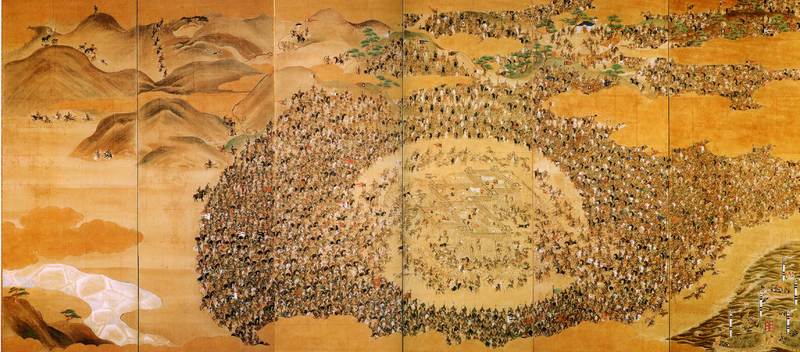
Korea is a geopolitical fulcrum in world history. Bordering continental Asia on one side, and maritime Japan on the other, it has sat uneasily at the foreground of international war. During the 17th century, Chosŏn Korea (1392-1910) faced a series of Japanese and Manchu invasions that nearly toppled the dynasty. During and after these wars, Chosŏn revamped its military around muskets, and this technological reform triggered cascading changes in Korean society. One such change was the establishment of new standing armies in the capital in order to raise musketeers. As a result, thousands of soldiers and families flocked to Seoul from the countryside to serve in these armies, and this indirectly led to economic growth: many of these new military urbanites were given special privileges by the state to set up shop in sectors as varied as trade, shipping, mining, and printing. Meanwhile, due to the high demand for arms, military merchants in the frontiers pursued international arms trade with Japan and China. These developments constituted, if you will, a process of military urbanism.
The Great East Asian War
"If you believe the world is divided into separate regions, that their talent and nature are distinctive, and that they are not mutually comprehensible, then how is it that [during the Zhou period of ancient China] the steel-clad soldiers of the Wu state learned the way of chariot warfare from [its rival state] Chu and ultimately used it to subdue the Chu? Regardless of whether one talks of antiquity or not, there were no muskets during recent times in the central plains of China; only from the Japanese pirates did the Chinese in Zhejiang Province start learning the way of the musket, with which [Chinese general] Qi Jiguang drilled his troops for many years until it became a Chinese skill, and with which he thereupon defeated the Japanese."
- Yu Sŏngnyong
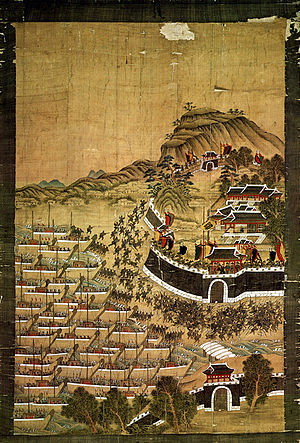
In 1592, a Japanese invasion of Korea set off the First Great East Asian War. For seven years, this war engulfed the Korean peninsula and its waters with international conflict of rare precedent in world history. Engaging three belligerent states – Ming China, Chosŏn Korea, and a newly unified Japan – the war featured colossal armies, mass-produced firearms and foreign mercenaries.
As war engulfed the Korean peninsula, Yu Sŏngnyong (柳成龍), Chief State Councilor of the Chosŏn dynasty at the time, urged the Korean military to retaliate against the Japanese invaders with muskets. Yu drew from historical as well as current examples to underscore the importance of military “adaptation and progress” and exhorted that, though musketry warfare was a foreign skill, it should be adopted and enhanced upon.47 Under Yu’s supervision and thereafter, the Chosŏn state quickly tuned into global currents of firearms warfare—via surrendered Japanese soldiers, Chinese exiles, and Dutch castaways—and started a process of military reform that revamped its armed forces around firearms and disciplined soldiers. Throughout the seventeenth century, Koreans combined Japanese musketry technology with Chinese infantry tactics and forged their own way of war, which depended heavily on musketeers.
The Great East Asian War was an unprecedented catalyst for Chosŏn military reform. The megalomaniac leader of unified Japan, Toyotomi Hideyoshi, invaded Korea in 1592 and stirred a war that would engage massive armies, embroiling as many as 900,000 soldiers and three belligerent states.48 The Japanese troops swept through Korean defenses with their capable musketeers and captured the capital within three weeks. They excelled at both musketry tactics and close combat but their naval forces paled in comparison to those of Chosŏn, which wielded superior cannons and threatened their supply lines. The war escalated further when Ming China sent auxiliary troops and helped turn the tide of the war. The Chinese brought artillery that dwarfed Japanese firepower in set-piece battles. Further, their Southern Troops (南兵), infantrymen drilled in the revolutionary tactics of the Chinese general Qi Jiguang (戚繼光), were lethal to the Japanese.
Bird Gun
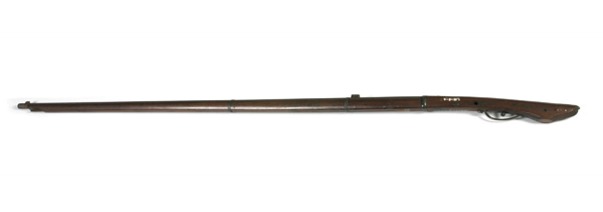
“The bird gun hits the target eight out of ten times, which is why it can even shoot down birds amongst the trees. The musket is a precise and deadly weapon because its accuracy is even superior to that of the bow and its bullet can penetrate multiple coats of mail. The precision of this weapon is ten times more accurate than the cannon and five times more so than the bow.”
– Qi Jiguang, c. 1588
In 1589, three years before the Great East Asian War (1592-1598) ripped through the Korean peninsula, Chosŏn King Sŏnjo received an unusual tribute from Tsushima – a pair of peacocks, and a gun that the king had never seen before. The latter was a musket, a deadly matchlock known as the “bird gun” (鳥銃) in East Asia. It was the weapon that would later blast through Korean ranks during the invasion, and a few decades after, become a mainstay in Chosŏn warcraft. But at the time, it failed to make an impression, and fared no better than the peacocks that Sŏnjo ordered to be released. The bird gun was stored away in the Weapons Bureau, hardly noticed.
During the Great East Asian War, the Sino-Korean allies realized that Japanese aggression was largely enabled by Hideyoshi’s superior musket units. Particularly shaken was Korean King Sŏnjo, who had witnessed Japanese musketeers blast through his army. When one of his officials downplayed the efficacy of Japanese musketeers, Sŏnjo retorted in fear that they could use the volley fire technique. He said: “If the Japanese divide themselves into three groups and shoot alternately by moving forward and backward (若分三運, 次次放砲), how can we fight back?” Despite the fact that the Japanese musketeers were special forces, only constituting about twenty percent of the Japanese army, their lethality was enough to make a deep impression on Sŏnjo. Indeed, he once stated that “the invariable victory of the enemy lies in their [use of ] firearms (且賊之全勝, 只在於火砲).”
From an unwanted item, the bird gun quickly rose to the top of Chosŏn kings’ wishlist after the war. During the early and mid-1600s, Korean appetite for Japanese arms grew to the point of necessitating reconciliation between the two erstwhile enemies. At the time, as the Chosŏn court recovered from the ashes of the war, it sought to capitalize on diplomatic relations with Tsushima and the peace-seeking Tokugawa regime to import high-quality weapons from the archipelago. In order to boost its military, Chosŏn sent embassies to restore relations with Japan and subsequently engage in arms trade.