The 'Digital Turn'
This project contributes to the 'digital turn' in Korean studies. To date, while digital archives have proliferated in South Korea since the late 1990s, digital humanities as a methodology has not gained traction in Korean studies. Addressing this asymmetry, my project uses recently digitized texts from 17th century Korea to explore the utility of digital methods in Korean historiography.
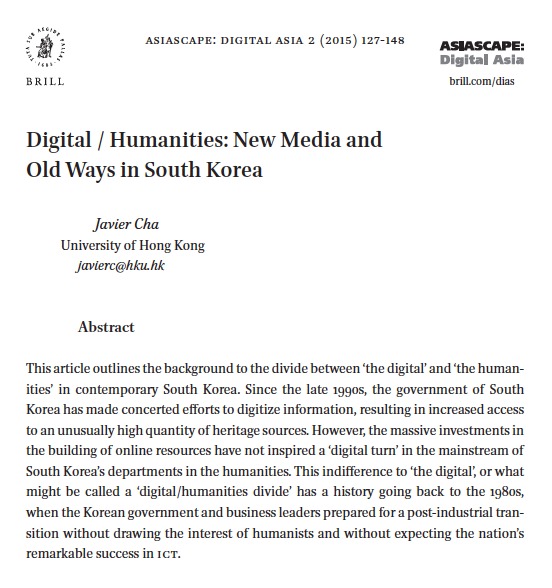
In a review essay, Javier Cha clarifies the origins of South Korea's stillborn digital humanities. Starting in the 1980s, the story goes, a divide between the 'digital' and the 'humanities' became deeply entrenched in South Korean society as a result of broad economic shifts. Specifically, as Cha puts it, the divide was a "product of the humanists’ deep involvement in South Korea’s nation-building and rapid industrialization in the 1960s and 1970s and subsequent disengagement from the technology- and service-oriented economic development that followed starting in the 1980s."
With this backdrop, the 1997 Asian financial crisis occurred, and the South Korean government issued stimulus packages to mitigate its catastrophic impact on the economy. Specifically, as part of the so-called Informatization Labour Project (Chŏngbohwa kŭllo saŏp 정보화근로사업), a massive fund worth $108 million USD was passed on to the Ministry of Communication and Technology to create 24,000 white-collar jobs involving the digitization of information, many of which were allocated to historical archives such as the Jangseogak Archives. This was the beginning of South Korea's massive digitization projects that continue until today.
As a result, one one side, there emerged a South Korean government continuing its immense output of digitized information of historical data, equipped with an annual budget as high as $66.4 million (which is 14 times larger than that of the NEH Office of Digital Humanities in the U.S.). On the other, the mainstream South Korean academia became further disengaged from the digital on a methodological level, despite enjoying the prevalence of easily accessible digital information.
Hence, the 'digital turn' in Korean studies is uniquely asymmetrical. Despite the overabundance of digitized information, and the accumulated potential for digital scholarship, there has yet been a satisfactory link between the two. As such, my project situates itself as a pilot attempt in deepening scholarly engagement with the digitized materials produced by the South Korean government.