Using Metadata
The hankachō (犯科帳) is ready-made for metadata analysis: containing essential biographical data such as name, age, address, role in crime and so on, the hankachō spans 146 books and 200 years of criminal records from 1666 to 1867. Regarding the 1667 incident, it occurs as the first item on this huge compilation, and with the comprehensive list of 94 suspects who were investigated.
In this section, I discuss using this data to analyze interpersonal ties between the criminals. Drawing on sociologist Kieran Healy’s article on “using metadata to find Paul Revere,” I approach the problem of smuggling as a historical detective, one that is empowered by hindsight and digital tools. In my quest, I seek to answer a triad of questions:
- Who were the main agents in arms trafficking?
- What were their structural and geographical positions in the network?
- What were the interpersonal ties between these agents in terms of their geographical location and participation in crime?
Comparing my answers with those of the Nagasaki contemporaries and of previous historians, I hope to use visualizations as a medium of discussing the investigative prowess (and limitations) of the Nagasaki magistrate office. Ultimately, this paper argues that network analysis of even “meagre metadata” can breathe new life into historical problems, generating hypotheses and suggesting alternatives to the existing historiography.
In the long run, this case study may serve as an incubator project for gathering more and better metadata from the rest of the hankachō, and using a data-driven approach to achieve a broad understanding of illicit trade in Tokugawa Japan.
Using Metadata
In a short article, “Using metadata to find Paul Revere,” Healy demonstrates the interpretative power of digital tools and metadata in identifying key individuals in Boston on the brink of the American Revolutionary War (1775-1783). Not unlike the task of locating leading smugglers in Japanese arms trade, Healy sets out to identify a needle – Paul Revere – in the haystack of suspects in Boston. With careful audacity, he collects and analyzes information on about 260 “suspects” and their varying membership in Boston’s seven different organizations (e.g., North Caucus, the London Enemies List). Despite that Healy’s haystack is meager, constituting “the merest sliver of metadata about a single modality of relationship between people [between people and organizations,]” his network analysis enables him to find Paul Revere with little difficulty. Indeed, Mr. Revere, the equestrian patriot, was a member of many organizations, occupying a structurally central position within the broad community of “suspects.” Healy’s approach to metadata is worthy of imitation and improvement.
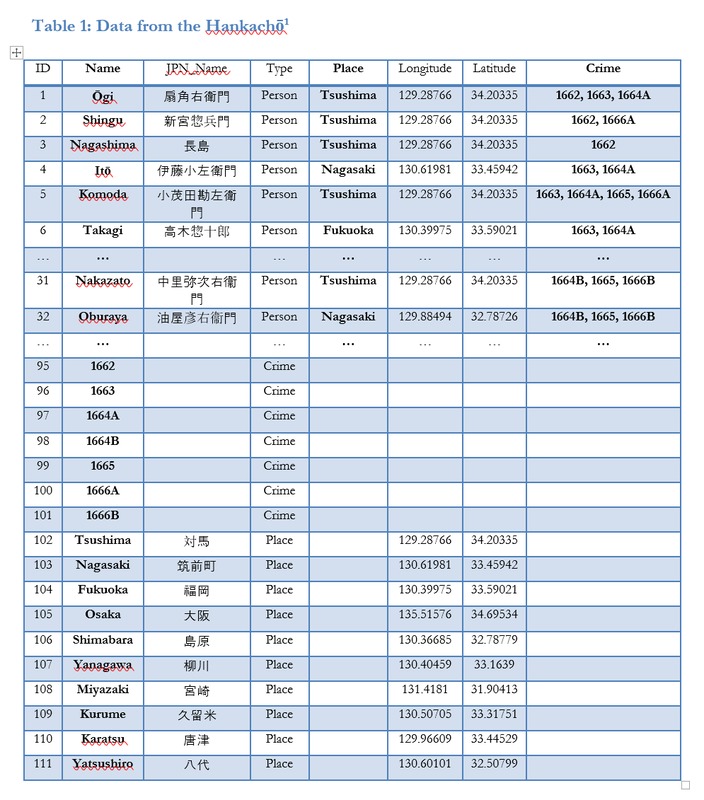
As for the 1667 arms smuggling case, the haystack is smaller but more complex than that of Paul Revere. The current dataset from the hankachō analyzes only a set of 94 unique individualsv from 10 Japanese towns, and their involvement in 7 smuggling initiatives from years 1662-1668 (See Table 1). Despite its seemingly meager size, it is nonetheless complete with all the suspects related to the 1667 investigation. In fact, by contemporary standards, 94 suspects (among whom 87 were punished) was a significant number of criminals caught and executed for a single investigation, as recognized by the bakufu at the time and emphasized in the secondary Japanese scholarship. Further, the current dataset, including three types of nodes – person, place and crime – is more complex than Healy’s, which opens up greater methodological possibilities. For instance, due to the ‘trans-regionality’ of smuggling networks, data from the 1667 investigation reflect particular attention to the geographic location of criminals. As shown in Table 1, I thus added a third feature of “place” to the otherwise binary analysis of person and crime. In terms of bimodal analysis, this translates to greater possibilities for exploring the varying combinations among the three types of nodes. In this way, I hope to use this incubator project as a testing ground for further enhancing approaches to metadata analysis.